Sunday, February 9, 2014

Fast and Furious!


 Today I'm going to talk about a lil ol' concept by the name of acceleration. What's acceleration you ask? Well my dear moomins, I will tell you! Acceleration is the change in velocity divided by the time it takes for change to occur. If you're new around here you may've missed my definitions from last time on velocity and speed. I'll include those since I'm feeling generous today. Speed is the distance an object has traveled in a unit of time and The velocity of something is its speed and direction of motion. Great now that that’s covered we can delve in deeper into the concept of acceleration!

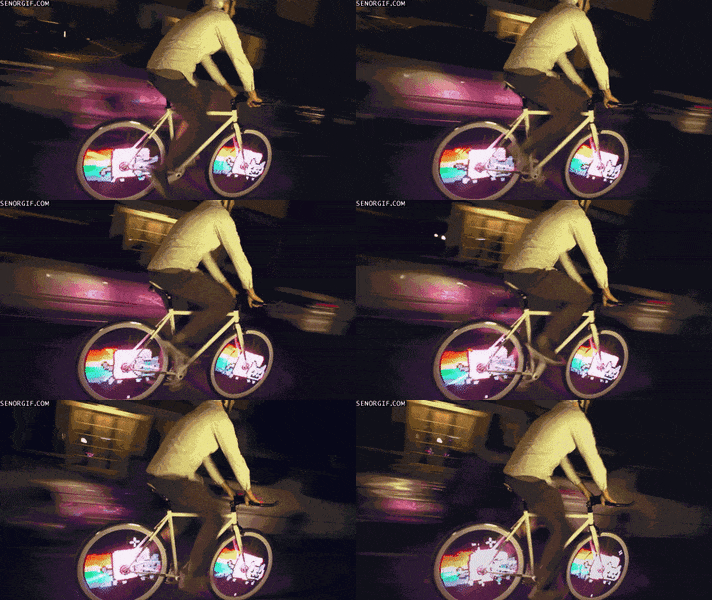
There are three ways to accelerate. The first is speeding up. Basically it’s when the speed of an object is increasing, so this changes the velocity. Because of this we get acceleration! When you’re riding a bicycle, the bike moves slow first, but as you continue pedaling your speed increases.  Next there’s the concept of slowing down. When an object slows down acceleration occurs in the opposite direction of motion. Let’s say you’re now biking a little too fast so you put your brakes on and come to a stop. The final is a change in direction. Velocity can also alter the direction of motion. This causes the acceleration of something to be at an angle to the direction of motion. An example of this would be riding your bike in a different direction, let’s say you turn right, since direction was altered, acceleration changed.
 
There is also positive and negative acceleration. Positive acceleration basically means your initial speed was less than your final speed. Negative acceleration occurs if an object’s final speed is less than the initial speed.  

Acceleration can be calculated by using the equation: final speed – initial speed divided by time.

Acceleration can also be graphed. You graph acceleration using a tool called a speed-time graph. If the line rises the object is speeding up, but if the line falls it is slowing down. A horizontal line represents a change of zero; acceleration is at zero or a constant speed.

 
I hope that helped everyone a little bit! If I don’t get the chance to say this next week I'm hoping your Valentine’s Day is perfect as cats!

links for photos:
Acceleration Formula
Nyan cat bike (I'm sorry for using this tired meme that should just die already)
Graphing acceleration
calculating acceleration
information from:
Glenco Science "Introduction to Physical Science"

Monday, January 20, 2014

SWEET (e)MOTION


      Hello everybody! Today we will be discussing the topic of motion if you couldn't tell by the Aerosmith referenced title. I've gotta shoe-horn those rock n' roll references in there somehow! Anyways, what is motion? To give you an abstract definition of this principle; it’s something that is really always occurring. You usually say that a person sleeping is motionless, but this is not true. Everything at all times is in motion. Even things like rocks or mountains are really moving. 
 Another example of things being in motion is their changing position. When something moves from one place to another, it is changing its position and is in motion. An example would be a swimmer paddling from one end of the pool to another. The swimmer’s position changed, thus they performed motion.

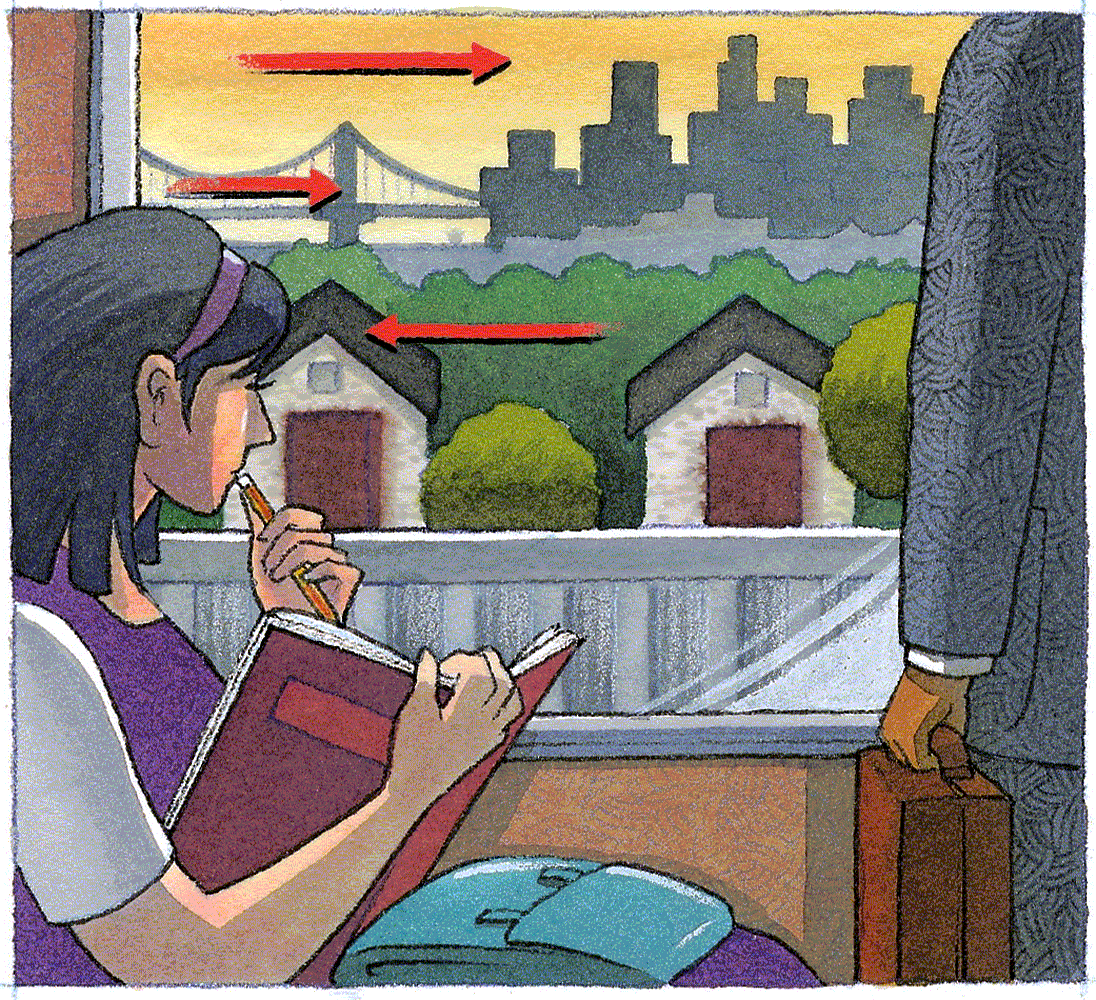
      Next we should go over relative motion. Determining if something altered its position, you need a point of reference. Cats barely move at all throughout the day and it’s pretty difficult to detect a change in position without using a reference point. Let’s say my cat is sleeping by a chair and then later on it moves to the other side of the chair. I can tell the cat moved by looking at its position relative to my reference point; the chair.


      You often hear about distance when dealing with motion and travel but have you ever heard of displacement? People often confuse the two together despite them being different. Distance is the entire length something has traveled whereas displacement is the difference in position between an objects starting and ending points. So if a guy walked 500 miles, then walked 500 more, just to be the man who walked a thousand miles to fall down at your door, the distance would be from his start point to his end point, your door where they fell at, which is a distance of a thousand miles! Another example of distance would be how far you walked from your house to your neighborhood pool. The displacement would be the distance between your house and the pool coupled with the direction you traveled; let’s say west.


      Another very important concept beneath the umbrella of motion is speed. Speed is the distance an object has traveled in a unit of time. An example would be a car going 54mph; for every hour the car travels it is going 54 miles. To graph speed you use something called a distance-time graph. This lists an object in motion’s distance over its time. Average speed of something can be found by dividing the total distance of something by the total time taken by it. This is different from instantaneous speed. Instantaneous speed is the speed of an object at one instant in time. For example, let's say we've got a pickup truck blasting Lynyrd Skynryd from the radio as the driver travels to his sister's wedding; the truck's average speed may be 70mph (ten miles above the speed limit!), but its instantaneous speed at one point in its voyage could’ve been different. Perhaps the driver had to stop at a gas station to pickup a wedding gift; therefore the truck’s instantaneous speed at this point is 0mph.


      Velocity is the final concept I will be discussing. The velocity of something is its speed and direction of motion. If a car is going north at a speed of 30mph; the car’s velocity will be 30mph north.


This formula is almost rigtht, but direction also should be factored in
      That’s all there is to it for discussing the rudiments of motion.  I’ll leave you all with some interesting facts about animals and their speed. The top 10 fastest land animals are:

10. Gray Fox
9. Coyote

8. Cape Hunting Dog
7. Elk
6.  Quarter Horse
5.  Lion

4.  Wildebeest
3. Springbok

2.  Pronghorn Antelope

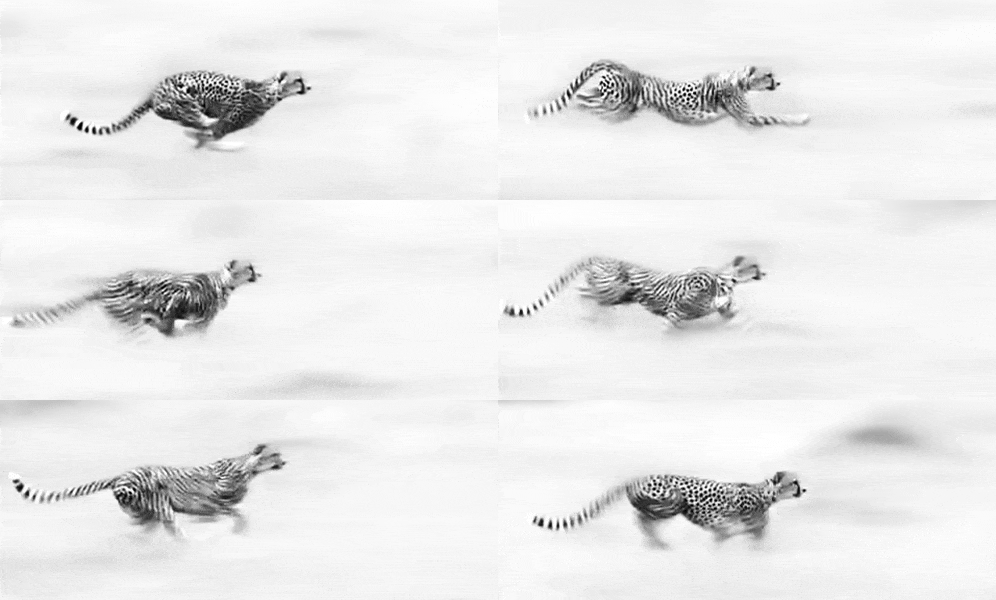
1. cheetah


image credits:
Relative Motion
Speed
Velocity
Distance and Displacement
cheetah gif
iformation credit:
Glenco Science "Introduction to Physical Science" pages 282-287

Monday, December 16, 2013

Apple doesn't fall far from the tree

Sir Isaac Newton is probably one of the most well known and influential scientists of all time. That’s quite a hefty title; It’s very well deserved though! Here I’ve got an allegory to help you all understand how darn important this guy is. He’s basically to science as Elvis Presley is to Rock n’ Roll. In retrospect Newton may be more important though.  Sadly, Sir Isaac Newton’s life wasn’t a very happy one at first. Let’s learn a bit more about this, dare I say, genius.


       Newton was born on Christmas day in Woolsthorpe manor England (or January fourth according to another popular calendar that England was using. Britain was just a really indecisive country) way back in 1642. He was the son of a skillful farmer, who also happened to be named Isaac Newton. Sadly, his father died before Newton was born. That’s pretty tragic, because he never got to witness all the exceptional things his child achieved. If that wasn’t depressing enough poor Isaac was born premature. This means he was born too early and hasn’t yet fully developed. Now back then, the infant mortality rate was of megalithic size when contrasted to know, so even healthy babies had a very big chance of dying. Its miraculous Newton survived. Now, Newton’s mum remarried when he was three, and then Newton went of to live with his maternal grandmother.
      Young Newton was a pretty precocious fellow, very intrigued by mathematics and science. He’s normally noted as being one of the first to employ the scientific method. However, his mother wished for him to fill his birthright as farmer. Newton hated farming, so this wouldn’t have been good. Supposedly, one of Newton’s teachers convinced her to let him continue his education. She agreed to let him go to college, so Newton set off to Cambridge! Thank goodness, can you all imagine what the world would be like if Newton became a farmer!

       Isaac Newton is a wild frat boy in college now! Okay, well, he probably wasn’t attending many frat parties, but I’m sure he was at least glad that he didn’t have to be a lousy farmer. Strangely, Newton was at first just a satisfactory student, but nonetheless he snagged his bachelor’s degree. Just in time too, because Cambridge had to close because of the, wait for it, Black Plague! Jeez the doctors sure were spooky. 
 
      Newton had to return home to Woolsthorpe for an entire year while the Bubonic Plague was on the rampage. That’s not all bad news because this was definitely Newton’s intellectual highpoint, his year in Woolsthorpe is even dubbed “Newton’s miracle year” (psst; kind of like how 1989 was The Cure’s highpoint because of how successful their LP Disintegration was). It’s called his miracle year because he made many pretty miraculous discoveries. Jeez, I don’t do stuff like that when I’m on leave from school, Newton’s making me look bad! 
      Allegedly, Newton was struck on the head by an apple and that got him thinking and he came up with the concept of gravity; Whoa.  He also came up with three laws of motion. First, an object at rest tends to stay at rest. Next he discovered that acceleration is produced when a force acts on a mass; Force= mass times acceleration, and Finally, for every action there is an equal and opposite reaction.  His Woolsthorpe endeavors also included him making contributions to the optics field. Newton revolutionized things yet again by coming up with the notion that light isn’t actually white. He discovered this by using a prism that diffracts light. The prism, called a dispersive prism,  is the same kind found on Pink Floyd’s Dark Side of the Moon album (Wow, that rock n’roll reference was actually easy to make this time). 
 
       He invented a reflecting telescope which made images viewed through it clearer opposed to preceding models. Newton also worked with money as well and helped prevent counterfeiters.  Newton also published a massive tome containing many of his observations referred to as “the Principia” Oh, yeah, he also created calculus. Seriously, that’s all super impressive and makes me feel so insignificant; I just want to cry in the corner while I listen to The Smiths and The Cure; I already do that though.
      Newton received many accolades for all of his accomplishments; thank goodness! Isaac Newton was knighted by Queen Ann for his contributions; an honor that was seldom given to scientists. Newton became president of the Royal Society and was re-elected every year until his death in 1727 at the ripe old age of 84. Then he was buried in Westminster Abbey; a tremendous honor.
 
      Isaac Newton had a rough start, but he went on to make waves in the field of science and math. I maintain that he’s a bit more important than Elvis Presley; wow, that was really hard to admit. I’ll leave all of you with some interesting factoids that I forget to fit in-between all the forced rock references.

FACTS:
Newton never married

“Newton’s” are units of measurement used to calculate force; named after Isaac newton.

I hope you all enjoyed that; leave a comment!
 
information is from: here
picture links are highlighted

Monday, December 9, 2013

Bringin' the Heat

It’s that time of year where all the other girls trade their skirts and summer dresses in for leggings and those trendy sweaters. Me? Oh well, I just wear jeans and post-punk band tee shirts all year round. Anyways, the point is, things are getting cooler as the female populous’ attire shows. I propose that we learn about something especially relevant this time of year: heat! Specifically how heat transfers so we learn how we stay toasty. First, before we go more into that, let’s briefly talk about temperature. Temperature is a measure of the average value of the motion of molecules. The more energy molecules have, the faster they move. Heat transfer is the transfer of thermal energy, always from a warmer object to the cooler object. The cooler object will become warmer and the warmer object cooler. There are three main ways that thermal energy is transferred: conduction, radiation, or convection.
            Conduction is the form of heat transfer via direct contact. It occurs mainly in solids and liquids. The atoms and molecules within the substance only move a short distance before they contact each other. That’s the reason it happens more in these matter states than in the gas state; because the atoms and molecules are closer together inside solids ad liquids. An example would be eating a hot french-fry and burning your tongue because you couldn’t wait a few minutes for it to cool down. Also touching a hot metal handle with a bare hand is an example of conduction; and stupidity. Both of these examples were experienced firsthand.

Radiation is received by light and heat. It is the only form of energy that travels in space. This is perhaps the most important form of heat transfer when it comes to all the ways we use it. We use radiation heating when we warm ourselves by a fire, and most importantly from the sun.

                                                        
Convection is another way to transfer thermal energy. This is the transfer of energy by the movement of atoms and molecules. Convection occurs mainly between liquids and gasses because the flow of these two forms is a lot more fluid than solids. These easily moving particles travel from one place to another while transporting energy. An example of this would be a pot of water getting heated on a stove.
Now that we know the rudiments of thermal energy we can talk about thermal conductors. Conductors are materials that easily transfer thermal energy. Conductors are used a lot in cooking for this reason.  That’s why your pots and pans are metal; they’re good conductors. Speaking of conductors, they sort of have an opposite; insulators. Insulators are materials in which thermal energy does not flow easily. Materials like fur, feathers, and plastic foam are all poor conductors, but great insulators.  Blankets keep you warm because they are really good insulators that trap your heat around you so you stay warm, obviously the same goes for feathers, fur, and clothing with good coverage. If something is a good conductor, like copper, it will be a weak conductor.
I also want to talk about how rooms stay warm. It’s in part to the insulation in your home, but also because heating systems. A heating vent should be placed on the floor in order to evenly heat a room, because the heat will travel up and down. If placed near the ceiling it wouldn’t heat the room as well.
Now for some interesting facts: Things with more molecules have more energy. Between a tiny, but burning match, and a large, ice sculpture, the sculpture will have more heat energy despite being frozen because it is larger and has more molecules! Things will also take up more space if they’re hotter. An interesting fact about convection is that it helps make the world habitable by keeping our temperature much cooler than it would otherwise be.

I’m pretty sure that about coves everything you should learn about heat transfer. Remember to stay warm this wintery season. Be sure to leave a comment!


links for images:
Types of Heat Transfer
Radiation
Convection
Conduction
Insulators
Conductors

Sunday, December 1, 2013

Video Games and the Uncanny Valley

The article observes the possibility of Video Games and their relationship to the Uncanny Valley. Let’s not get ahead of ourselves, and make sure we know about the uncanny valley. The name and concept was coined in the 70’s by robotosist Dr. Masahiro Mori to describe what happens when a robot becomes too realistic. He discovered that after creating robots with human characteristics, people liked them. However, as Mori made them more realistic, people expressed aversion to the robots. Scientifically, they were impressive, but these bots gave people the creeps. Bellow is the Graph Mori created of the uncanny Valley.

 It is used to express peoples’ affinity towards robots (and also computer generated characters). At the start of the chart, lie robots with very little human likeness. People usually respond rather indifferently to these. However, when more human-like qualities are added, there is a huge spike in likeability. That’s because we’ve given it a personality; it’s charming. Then, if more is added on to it, there is a massive fall in likeability, the graph dropping considerable. This creates the uncanny valley. As we continue on past this point, adding more and more to make it realistic, the human synthesizer will become so realistic that it’ll become indistinguishable from a person.  The affinity felt towards it by humans reaches a peak as it now practically is human.
The reason for why things that lie in the Uncanny Valley disturb us is simple: give something not human characteristics that give it humanity cause the object to be likeable, even relatable. However, if the object is almost human, but not quite there yet, it’s non-human characteristics become incredibly noticeable, and people respond with aversion. That’s because we as people know when something isn’t human; and that’s unsettling.
      Now, back to the article, it speculates that through recent game development, the uncanny valley is being destroyed. Before I continue analyzing this, I want to say that the uncanny valley isn’t being destroyed per-se, what these games are attempting to do is jump the valley. According to the Uncanny Valley graph, there are two points that will make for optimal human imitation. First, is the point before the uncanny valley, where things have human characteristics, but are clearly not human. This is stylization. Stylization is currently favored among game designers because of the aesthetic diversity they can achieve.  Notably, gaming’s most recognizable faces are all stylized ones.  The second point on Mori’s chart, after the uncanny valley, is Photo-realism. This is the point where the human simulation becomes so realistic that we accept it as normal.

      When it comes to video games, stylization has always been favored. This is because of two things: limited technology and apprehension. Obviously, for many years the possibility to create realistic human emulater( sorta like a fake copy of a person) just wasn’t there because of our limited technology. Also, the uncanny valley has always made animators, robotic engineers, and 3D artists, extremely weary of attempting that second point; trying to jump the valley seemed impossible. However, now we are making big headway in trying to jump the valley and reach photo-realism. More and more games are now being created where it shows how far we’re coming to reaching photo-realistic graphics. Sadly, though the future is bright, we are still clawing our way out of the valley. Still, with our technology we aren’t at photo-realism yet. I feel this is also attributed with how easy it is to screw up photo-realism. Speaking from the vantage point of an artist, I understand the strife game designers face. Let’s say I was to draw you. I would have to be very meticulous in trying to capture your likeness, and every mistake I make would be very clear for you, or someone else, to see. This is because as people we notice immediately when something is off. This is also the reason why I personally favor stylization. Even when I'm drawing a person, like an actor or singer, I go down the route of stylization. I'm not aiming for photo-realism I want a stylized look, but I also want the drawing to be recognizably that person. When drawing people it's very much like what game designers do. They can either go stylized or all the way realistic. Bellow in a drawing I referenced off a photo of Brad Pitt, I wanted the drawing to look like him, but I was not  aiming for photo-realism.
 
 
If a human character in a game has qualities that are not human, they become glaringly obvious.  It’s not  just appearance, like texture or anatomy, but also movement. In games, if a character does not move like how a person should, this annoys the person playing the game. Strangely, if a photo-realist character were to move in a glitchy way people respond with much more annoyance than if it were a stylized character like Mario. This is why most game designers still favor stylization; it gives much more room for error.  It is a very arduous, stressful process to make a photo-realistic character seem believable.
 
     Despite  all the work and worry game designers must face in order to achieve photo-realism, more and more are taking the risk, and it’s beginning to pay off. Recent games depicting near photo-realistic characters (like the Last of Us) are winning awards and overall impressing critics and players with their  realism.

Although we haven’t quite reached Photo-realism yet, it’s nice to see we’re well on our way.  Leave a comment and tell me what you thought. I hope you find the Uncanny Valley as interesting as I do

(All links for copyrighted images can be found throughout the above passages)


Sunday, November 17, 2013

You do not talk about energy

Howdy, everyone! Once again we shall be addressing quite an important and diverse subject. No, we sadly aren't delving into the deliciously complicated psyche of Robert James Smith; we're talkin' about the concept of energy. Energy is pretty difficult do describe. It's sort of like being asked what water tastes like; water! However, if I had to explain then I'd say this: energy is the ability to cause some action to occur. Energy can be transferred or stored. It can't be created or destroyed. Again we are dealing with a megalithic concept here with magnitudes of content inside it. Right now we're only worrying about Potential and Kinetic energy.

Both Potential and Kinetic energy pertain to movement; motion. Potential energy is the energy a thing will have due to it's placement. A super generic example would be a pebble perched precariously on an ant-hill. Now let's say that pebble is a boulder and the ant-hill it was on is now a mountain! The boulder on the mountain has more potential energy than the pebble on an ant-hill. That's because the higher an object is and the more mass it has, the more Potential energy.


 Kinetic energy is the energy that a moving object has. The more speed and mass an object has the more kinetic energy. If the pebble begins to roll down the anthill it will have less energy than if the boulder rolls down the mountain. That's because again when something has more mass the more kinetic energy it will have.

Also, kinetic energy can be transferred from one object to another. It's against the rules to talk about this ,but it's a fantastic example. Let's say you're in Fight club, right? Okay, so you're Tyler Durden, and all of your bros are circling you and this other guy. That's because you and he are about to engage in an epic rumble of bro-ness. You, being Tyler Durden, punch this fella and, Wham, down goes Frazier! When you, Tyler Durden, punched that guy's face you were transferring energy. Also, pain, but mostly energy. Quite a lot of energy too!


That's about all, folks! please leave all comments, milkshakes, Simon Gallups, Robert Smiths, and puppies down bellow. All information from notes in class and probably Brainpop.


links:
Frazier

Sunday, November 10, 2013

It doesn't Matter

     Howdy, everyone! Today we’ll be talking about something that matters a whole lot; matter! Seriously, though matter is insanely important. Even more important than that Cure album I’ve been wanting; yeah that’s pretty dog garn important! Matter is everything under the sun; it even is the sun. That’s because matter is anything that takes up space. Matter is you, me, cheeseburgers, Brad Pitt, India, computers, Mars, budgies, Budgie, the moon, the Disintegration album, nail polish, Wisconsin; you get the idea.  In case you hadn’t figured out by now, matter is a huge multi-faceted concept, so we’ll be taking it on little by little. First, let’s learn about how matter changes states.
      There are three states of matter: solids, liquids, and gases. Matter changes states when exposed to pressure and temperature changes. I'd like to mention that no matter what state of matter a substance is in, it will retain it's chemical properties. Sort of like how when you wear a super cute outfit and curl your hair one day, but then the next day you just wear sweats and a ponytail. You're still you, only your physical appearance changed.

      First, let’s talk about solids. Solid is the state of matter where the molecules within something are tightly packed together. Solids have a definite shape and volume under normal conditions. A good example of a solid would be ice.
      Next let's talk liquids. Liquids have a fixed volume, but not a fixed shape. The molecules inside liquids are fluid, just like liquids themselves! An obvious example of liquids would of course be water. Solids become liquids after reaching a melting point. Ice's melting point is 32 degrees. This also bleeds into heat of fusion. Heat of fusion is all energy being put towards melting something. If you were to be boiling a bunch of ice and put a thermometer in it, the heat will not rise until all the ice has melted. Neat, huh?
      Finally, we have the gas state. In the gas state molecules within the gas will move around randomly and wildly. Gases have no fixed shape or volume. A good example of a gas would be water vapor. I should also mention Heat of Vaporization. It's a lot like Heat of Fusion, only this is where all energy is spent turning something into a gas. Again, if we I were to boil water, the temperature would remain the same until the water has evaporated.
      Those aren't really the only three; they're just the main ones. There are still Colloids and Plasmas which I'll go into briefly. Plasmas are electrically charged gases, like stars and lightning.
 Colloids are a mixture that contains two different phases of matter. An example would be pudding, milkshakes, yogurt, smoothies, dang it I'm hungry now!

      Finally, let's talk about Condensation, Sublimation, and Deposition. Condensation is the process of a gas turning into a liquid. Ever leave a water bottle out on a hot day? Notice all those water droplets covering the inside? That's from condensation. Next we have Sublimation; a gas turning into a solid. An example of this would be Carbon Dioxide into Dry Ice. Speaking of dry ice; that's where all that awesome fog comes from during Iron Maiden Performances! Finally we have Deposition. Deposition is the concept of gas changing to a solid. That's what causes frost patterns on your windows in the winter!

     Well, I think that's all that matters. Sorry about that one; I hope this helped you guys out! Leave I comment or else I will drink your milkshake. Actually, I'd drink your milkshakes whether you comment or not.